- Home
- St. Jan Bay
St. Jan Bay
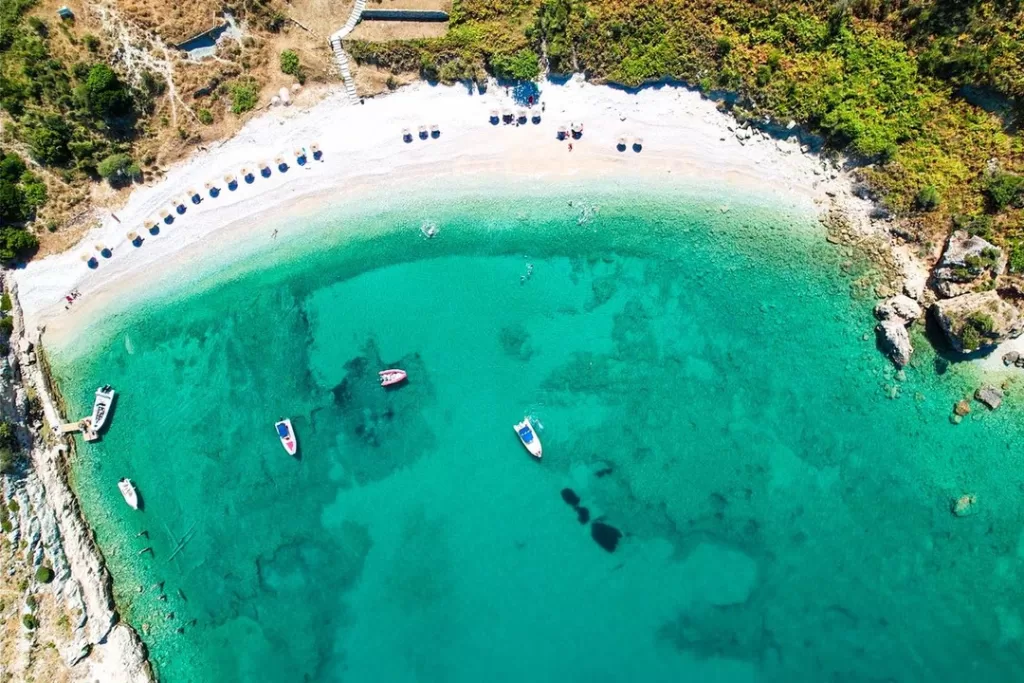
St. Jan Bay, also known as Kongjorufa Bay, is located between Cape St. Jan to the east and the southeastern stretch of coastline that continues from Cape Gallovec. The shoreline of this bay is rocky, particularly on the western side, which descends steeply into the sea. The eastern side, by contrast, features lower rocky formations. Only at the southern end of the bay does the shoreline gently slope into the sea, forming a small beach area.
On the southern shore of the bay, about 80–100 meters from the coastline, there is a large single-story building made of white stone, now partially ruined. In the southwestern part of the bay—where the beach ends and the coastal slope of the western shore begins—there is a well. The well provides drinkable water, although during the summer, the water becomes salty.
Depths in St. Jan Bay, Karaburun
Cape St. Jan, which borders the bay on the eastern side, is rocky, has a jagged coastline, and is generally low with gentle slopes. The cape is bare, except for two large isolated trees. On the northeastern side of the bay, about 60 meters from Cape St. Jan, lies a flat, jagged rock formation resembling an island. It is partially exposed above water, with the rest submerged.
St. Jan Bay is deep. The 20-meter isobath passes:
150 meters from Cape St. Jan,
300 meters from the southern shore
100 meters from the western shore.
The 5-meter isobath runs:
30 meters from the cape,
95 meters from the southern shore
right along the western shore.
The 2-meter isobath passes 30 meters from the southern shore. Along this part of the coast, submerged and semi-submerged rocks are frequently encountered.
Approach to the rocks bordering the bay from the east is only possible from the western side and must be done with great caution. Access from the north or east is not advised due to shallow waters and underwater rocks. On and to the east of Cape St. Jan are several ruins of destroyed buildings.
The bay is protected from southern winds and partially from western ones. These conditions make it a potential shelter for boats. The seabed is mainly muddy, though rocky patches are also commonly found.